 Tulum City Guide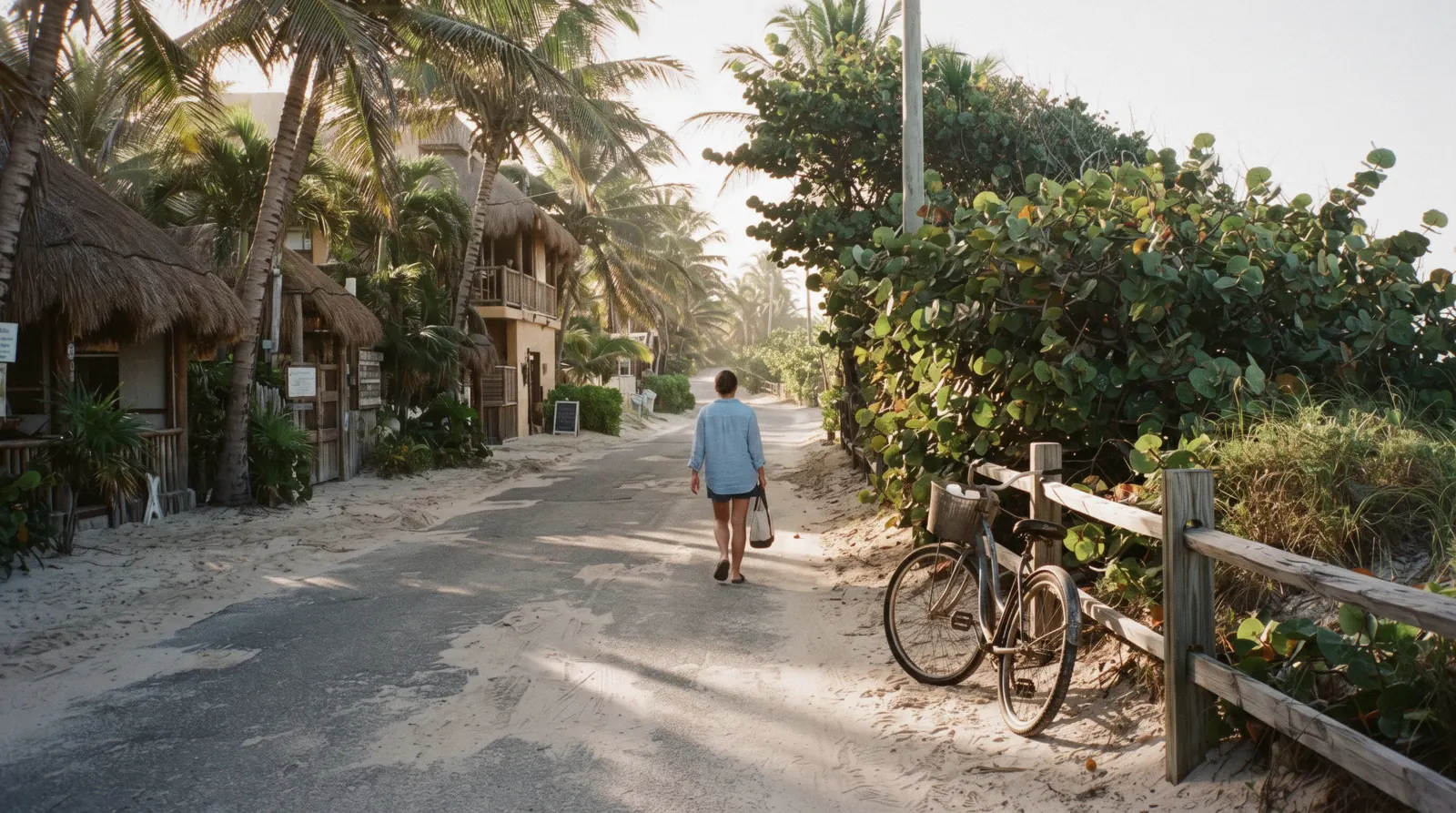
The Tulum Hotel Zone
The Tulum hotel zone is the ten-kilometre beach road behind the dune, and it is a different holiday from the town four kilometres inland. It buys you sand at seven in the morning and costs you a taxi every time you need a cash machine. This page prices it honestly against the alternatives, using real midweek rates, the wider comparison is on where to stay, and the trip as a whole is planned around things to do in Tulum.
Quick answer What a night costs, and what the strip does not have
The beach road runs about ten kilometres south from the ruins, lined with small design-led hotels behind the dune. A midweek night in October ran $116–198, median $141. There is no supermarket, no bank and no bus terminal on it, much of it generates its own power, and the road into town is four kilometres and unlit.
Key takeaways
- You are paying for the walk to the water and for a supply chain that arrives by van — what the premium buys is specific
- Every beach in Mexico is public, including this one: staying inland does not cut you off from the same sand, and the beaches page lists the free access points
- Beach clubs on the strip charge a minimum consumption rather than an entry fee — how that works
- If your plan is the ruins, the cenotes and the reserve, the town is the cheaper base by a wide margin
The hotel zone against the other three areas
Rates are the middle half of what Google Hotels returned for one midweek night, Wednesday 14 to Thursday 15 October 2026, two adults, room only, queried on 29 August 2026. They compare areas rather than quote a room.
| Area | Typical night | To the sand | What you give up |
|---|---|---|---|
| Hotel zone (beach road) | $116–198, median $141 | On it | Shops, banks, cheap food, transport |
| Tulum pueblo | $67–133, median $96 | About 4 km | The morning swim from your door |
| Aldea Zamá | $78–152, median $109 | About 3 km | Walkability in either direction |
| La Veleta | $34–83, median $43 | About 5 km | Paved streets and proximity |
The gap is the whole argument: the strip runs about three times La Veleta's median for a room five kilometres from the same public sand. On a short trip that can be worth it; on a long one it rarely is.
What you will be doing from the strip
Every trip on this list collects from the beach road as well as the town. Prices as listed by GetYourGuide.
 from $35.87
2-Hour Tulum Snorkel: Sea Turtles, Stingrays & Coral Reef
Two hours, two spots on the reef inside Tulum National Park, gear and tips included. The cheapest hour in the sea, straight off the beach.
Check Availability from $26.09
Riviera Maya: Tulum Ruins, Mariposa & Chen-Ha Half-Day Tour
The cheapest way to pair the ruins with two cenote swims — hotel pickup, a guided walk, then Mariposa and Chen-Ha. Biggest review count here.
Check Availability from $174.94
Riviera Maya: Sian Ka'an Reserve Ancient Maya Canals Tour
Run by the Maya cooperative that holds the permit: the float down the thousand-year-old canal at Muyil, four ecosystems, breakfast on the early departure.
Check Availability from $105.67
Tulum Jaguar Park Day Pass: snorkeling, lunch at the beach, and exploring the area
A full day inside Parque del Jaguar — transport, guided walk, reef snorkel and lunch by the sea. For the beaches, not the temples.
Check AvailabilityPrices, ratings and details are the platform's own. Dollar figures are the listed prices. The platform bills in your account's currency.
The geography of the strip
It is longer than it looks on a map, and the north and south ends are different places.
The road starts at the junction near the ruins and runs south past the public beaches, the fishing beach at Playa Pescadores, then the long hotel stretch, and eventually to the Arco Maya gate where Sian Ka'an begins and the pavement ends.
The north end is closest to the ruins and the public sand, busier, and the easiest to reach by bicycle from the town. The middle is the postcard: the hotels, the beach clubs, the restaurants. The south end is quieter, darker at night and further from everything, which some people pay extra for and others regret by the second evening.
One practical consequence of a single road: the evening traffic between six and eight is genuinely slow, and a taxi from the far south end to the town at that hour is neither quick nor cheap.
Power, water and the things nobody mentions
The infrastructure on the strip is unlike the town's, and it shapes the stay in small ways.
Many properties run on generators or a hybrid supply, which means air conditioning is sometimes limited to certain hours, and it means the occasional cut. Water is often trucked and stored; hot water can be solar and therefore best in the late afternoon. Wi-Fi ranges from excellent to decorative, and "digital detox" on a hotel's website sometimes means exactly that.
None of this is a problem if you know it in advance, and all of it is worth asking about before booking if you intend to work, or if you need reliable air conditioning between May and September. In the town and the inland grids, the grid is the grid.
- Ask about power if you need air conditioning overnight or a reliable desk
- Ask about hot water if you shower late in the evening
- Bring a torch — the road and many properties are deliberately dark
- Mosquitoes are worse behind the dune than in the town
- Cash — smaller places on the strip still prefer it, and the ATMs here charge the most
When the beach road is the right choice
There is a clear answer, and it depends on the length of the trip rather than the budget.
Two or three nights, and the beach is the point. Stay here. The premium buys you the thing you came for and you will barely leave the strip.
A honeymoon or an anniversary. Stay here. The small properties on this road do that better than anywhere in the region.
A first visit that includes the ruins, the cenotes and Sian Ka'an. Stay in the town: the plan uses the town's geography, and the strip adds a fare to every leg.
A week or more, or with children who eat constantly. Stay inland. Aldea Zamá for apartments with kitchens, La Veleta for the budget.
The hotel zone on the map
The strip from the ruins junction south to the reserve gate, and the town four kilometres inland.
The alternatives, priced
Three other places to sleep, all within five kilometres.
Tulum pueblo
The working town: ADO terminal, banks, taquerías and a twenty-minute cycle to the sand. Tulum pueblo is the base this site's itineraries assume.
4 km inlandAldea Zamá
Apartments with kitchens, paved streets and pools, between the two. Aldea Zamá suits families and hire cars.
3 km from the beachLa Veleta
The cheapest beds near Tulum by a wide margin, and where the long-stay crowd lives. La Veleta needs a bicycle.
5 km from the beachSee what is available on the beach road
The band is the middle half of the rates Google Hotels returned for a midweek night, 14–15 October 2026, two adults, room only. Follow the link for a live search with your own dates.
Tulum hotel zone (Boca Paila road)
- Walking distance
- On the sand; about 4 km from the town centre
- Typical double
- $116–198 a night (median $141)
- Suits
- Short trips built around the beach, honeymoons, anyone who will not leave the strip
No supermarket, bank or bus terminal on the road; power is often generated and water trucked in.
See stays in Tulum hotel zone (Boca Paila road)The north end, near the ruins
- Walking distance
- Closest to the public beaches and the archaeological zone
- Typical double
- Within the same band, generally at its lower end
- Suits
- Cycling to the ruins and the town, free beach access
Busier by day, closer to everything, and the easiest end to reach without a taxi.
See stays in The north end, near the ruinsRates for one midweek night, shown to compare areas, not as a quote. We may earn a commission if you book through these links, at no extra cost to you.
The Tulum hotel zone: what people ask
How much is a hotel in the Tulum hotel zone?
Is it worth staying on the beach in Tulum?
For two or three nights built around the sand, yes. For a first visit that includes the ruins, the cenotes and Sian Ka'an, the town is the better base — the plan uses its geography and the strip adds a taxi to every leg.
Is there a supermarket in the Tulum hotel zone?
No. There is no supermarket, bank or bus terminal on the beach road; the nearest are in the town, four kilometres inland along an unlit road with no metered taxis.
Do hotels in the Tulum hotel zone have reliable power?
Many run on generators or a hybrid supply, so air conditioning is sometimes limited to certain hours and cuts happen. Ask before booking if you need to work or need cooling overnight — the section above lists the questions worth asking.
Can you walk from the hotel zone to the town centre?
You can — it is about four kilometres, flat — but it is a hot, shadeless walk and the road is unlit at night. Twenty minutes by bicycle is the local answer; a taxi is a negotiated fare with no meter.
Is the beach in the hotel zone private?
No. Every beach in Mexico is federal public land — a hotel can own the building, not the sand. What a club sells is a bed, shade and service, through a minimum consumption rather than an entry fee: the beach-clubs page explains it.
Prices, hours and terms are set by the venue or operator and confirmed at checkout.
We may earn a commission if you book through one of our links, at no extra cost to you. Full affiliate disclosure