 Tulum City Guide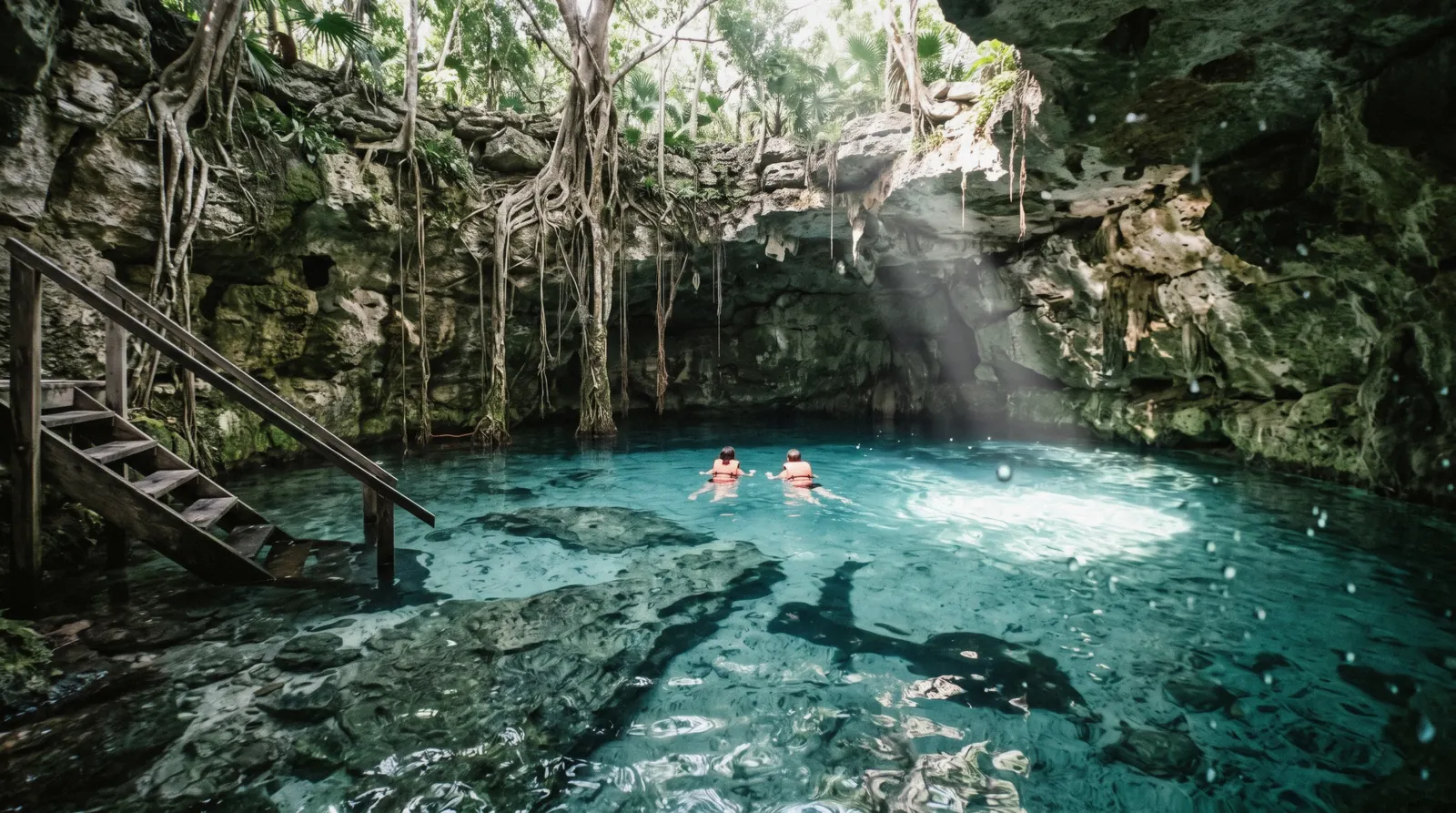
Tulum Cenotes
The Tulum cenotes are why the town is worth more than a morning: collapsed limestone that opens onto the longest mapped flooded cave system in the world, with water at about 24 °C all year. This page sets the ones within an hour of town side by side — what each is like, what it charges, and which of them will only take pesos in cash. For the rest of the coast, see what to do in Tulum.
Quick answer Which cenote, what it costs, how to reach it — in four lines
There are more than twenty swimmable cenotes within an hour of Tulum, and they divide into three kinds: open pools you swim in, cavern systems you snorkel through, and deep shafts for certified divers. Only Parque Dos Ojos publishes prices online — MX$400 for Dos Ojos, MX$300 for Nicte-Ha. Everywhere else you pay in cash at the gate, and the figure is not posted anywhere in advance.
Key takeaways
- For a first cenote, the cavern swim at Dos Ojos is the one that looks like the photographs — MX$400, and the only gate here that takes a card and holds a booking
- For a ten-minute trip from town, Cenote Calavera on the Cobá road is three holes in a limestone roof and a rope ladder; it is a jumping cenote, not a swimming one
- For the cheapest guided version, a shared tour with three cenotes and lunch replaces three cash gates, three taxis and a lot of standing at the roadside
- Bring pesos, leave the sunscreen: most gates make you shower first and biodegradable is the rule everywhere on this coast
The cenotes around Tulum, grouped by the road you take
Nine cenotes, numbered to the map, grouped by which road gets you there. Coordinates come from Wikidata where an item exists and from the park's own site for Dos Ojos. Prices are marked as published or not published — that distinction matters more here than any ranking.
The Cobá road, west of town
-
Cenote Calavera
Jump Not published1 h
Three holes in a flat limestone roof — one wide, two small — with a wooden ladder down into a round chamber. The jump is the point; the swim is a circle of blue under a hole of green.
Tip: Ten minutes by bicycle from Tulum town, which makes it the one cenote you can do before breakfast.
-
Gran Cenote
Swim and snorkel Not published2 h
The busiest cenote near Tulum and, on a quiet morning, still the best introduction: two open pools joined by a cavern passage, turtles on the bottom and bats in the roof.
Tip: Neither the ejido that runs it nor any official page publishes a price or an opening time — bring cash and arrive at opening.
-
Cenote Zacil-Ha
Swim Not published2 h
A small square pool with a zipline over it and a shallow end that suits children. Less cave, more swimming pool, and the calmest water of the three on this road.
Tip: The quietest of the Cobá-road cenotes in the middle of the day, when the other two are full.
North on Highway 307
-
Cenote Dos Ojos
Cavern snorkel MX$4003 h
Two flooded eyes joined under a rock, on the Sac Actun system — over 376 km of mapped galleries. The cavern lines are lit by daylight from the openings, which is why it photographs the way it does.
Tip: The only park here that sells online, takes cards and refunds a cancellation made more than 48 hours ahead.
-
Cenote Nicte-Ha
Swim MX$3001.5 h
Inside the same park, and the opposite experience: a shallow lily-covered pool with turtles, good light and no cave. The cheapest ticket in the park at MX$300.
Tip: Pair it with Dos Ojos on one entry day rather than driving out twice.
-
Cenote El Pit
Dive only MX$1,800Half day
The deepest cenote in the park, with a halocline and shafts of light that reach far below the surface. Certified divers only, and priced accordingly at MX$1,800.
Tip: Not a snorkelling site under any circumstances — the interest starts below 20 metres.
-
Casa Cenote
Open channel Not published2 h
Not a hole in the ground but a mangrove channel that runs to the sea, so the water is brackish and moves. Snorkelling here is a drift along the roots with fish coming in from both ends.
Tip: The one cenote that suits a nervous swimmer: it is shallow, open to the sky and never feels like a cave.
-
Cenote Cristalino
Swim and jump Not published2 h
Forty minutes north of Tulum on the highway, a long open pool with a jump platform, a cavern overhang at one end and mangrove at the other.
Tip: Far enough north that it makes sense on the drive to or from Playa del Carmen, not as a trip from Tulum on its own.
South of town
-
Laguna Kaan Luum
Lagoon Not published3 h
A shallow turquoise lagoon with a deep cenote shaft at its centre, roped off because it drops to about 80 metres. You swim the shallow ring, which is warm, wide and waist-deep.
Tip: The one place near Tulum that reads as a beach day without a beach club, and the only one where a drone would be legal — the park, not us, sets that rule.
Numbers match the list — tap a pin for the guide.
What each cenote charges, and which ones publish a price
The important column here is the last one. Only Parque Dos Ojos publishes a tariff on a site of its own; everywhere else the figure is set by the ejido or the owner, collected in cash at a hut, and posted nowhere. Dollar figures are approximations at US$1 = MX$16.95.
| Cenote | Price | What it is | Published where |
|---|---|---|---|
| Cenote Dos Ojos | MX$400 | Cavern snorkel, two openings | dosojospark.com |
| Cenote Jaguar, same park | MX$350 | Jump platforms and a zipline | dosojospark.com |
| Cenote Nicte-Ha, same park | MX$300 | Shallow lily pool | dosojospark.com |
| Guided tour of several park cenotes | MX$1,200 | Guide, several cenotes in one visit | dosojospark.com |
| Cenote El Pit, same park | MX$1,800 | Deep dive site, certified divers | dosojospark.com |
| Gran Cenote | Not published | Two pools and a cavern passage | Nowhere — cash at the gate |
| Cenote Calavera | Not published | Three holes, ladder, jumps | Nowhere — cash at the gate |
| Casa Cenote | Not published | Brackish mangrove channel | Nowhere — cash at the gate |
Children at Dos Ojos: under 4 free, 4 to 12 at a reduced rate, adult rate from 13, with ID required at the window. No other cenote near Tulum publishes a children's rate, which is another reason to carry small notes.
The cenotes that publish nothing, and what to expect at each
Five of the best-known cenotes around Tulum have no website, no published tariff and no way to pay before you arrive. That is not a scandal — most are run by the ejido whose land they sit on — but it changes how you plan the day.
Gran Cenote
Four kilometres west of town on the Cobá road, and the one most first-time visitors are sent to. Two open pools joined by a cavern passage you can snorkel through, with small turtles on the sandy bottom and bats in the roof of the cave section. It is also the busiest: by mid-morning the boardwalks are full and the water has lost its glass.
Neither the ejido that runs it nor any government page publishes a price or an opening time — carry pesos in cash and arrive when it opens.
Cenote Calavera
Three holes in a flat limestone roof, ten minutes by bicycle from town: one wide enough to jump through, two small ones that give the formation its skull name. A wooden ladder drops into a round chamber where the light comes down in three columns. This is a jumping cenote — there is no shallow end and nothing to swim around — and it is the one to do before breakfast, when the rope swing is free and the light is coming in straight.
No price published.
Cenote Zacil-Ha
Eight kilometres out on the same road, and the most swimming-pool-like of the group: a small square basin with clear shallow water, a zipline over it and a paved edge. Families use it for exactly that reason. It is also the one that stays calm when the other two on this road are full at noon.
No price published.
Casa Cenote
Twelve kilometres north at Tankah, and not a hole at all: a brackish mangrove channel that runs to the sea, so the water moves and the fish come in from both directions. Snorkelling here is a slow drift along the roots rather than a descent into a cave, which makes it the easiest of the group for a nervous swimmer. No price published; the kayaks and guides at the entrance set their own rates in cash.
Laguna Kaan Luum
Nine kilometres south of town, a wide, warm, waist-deep lagoon with a deep cenote shaft at its centre — roped off, because it drops to about eighty metres. You swim the shallow turquoise ring, which is the closest thing near Tulum to a beach day without a beach club. No price published, and the rules at the gate change with whoever holds the concession, including whether a drone may be flown.
Cenote tours from Tulum
Four options that cover the two problems with doing this independently: the cash-only gates and the transport between them. Prices as listed by GetYourGuide.
 from $165
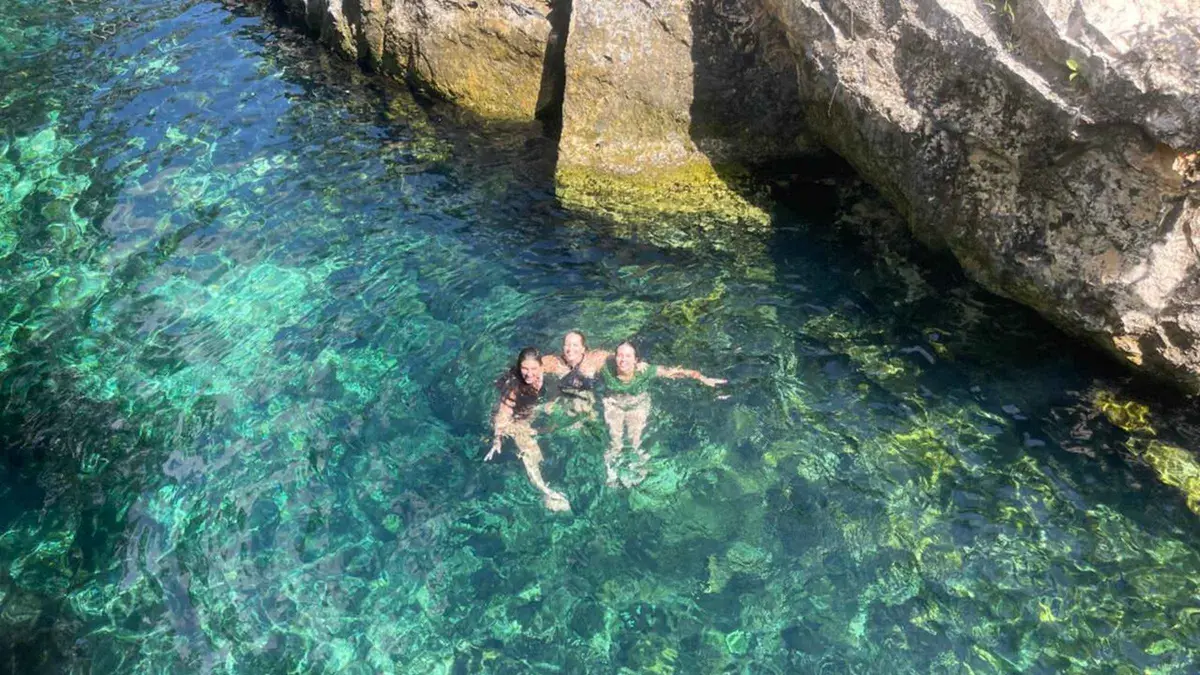
Tulum: Cenote Exploration Tour with Lunch and Snorkeling
Three cenotes in one afternoon with transport, life vests and a traditional lunch — one booking instead of three cash gates and a taxi.
Check Availability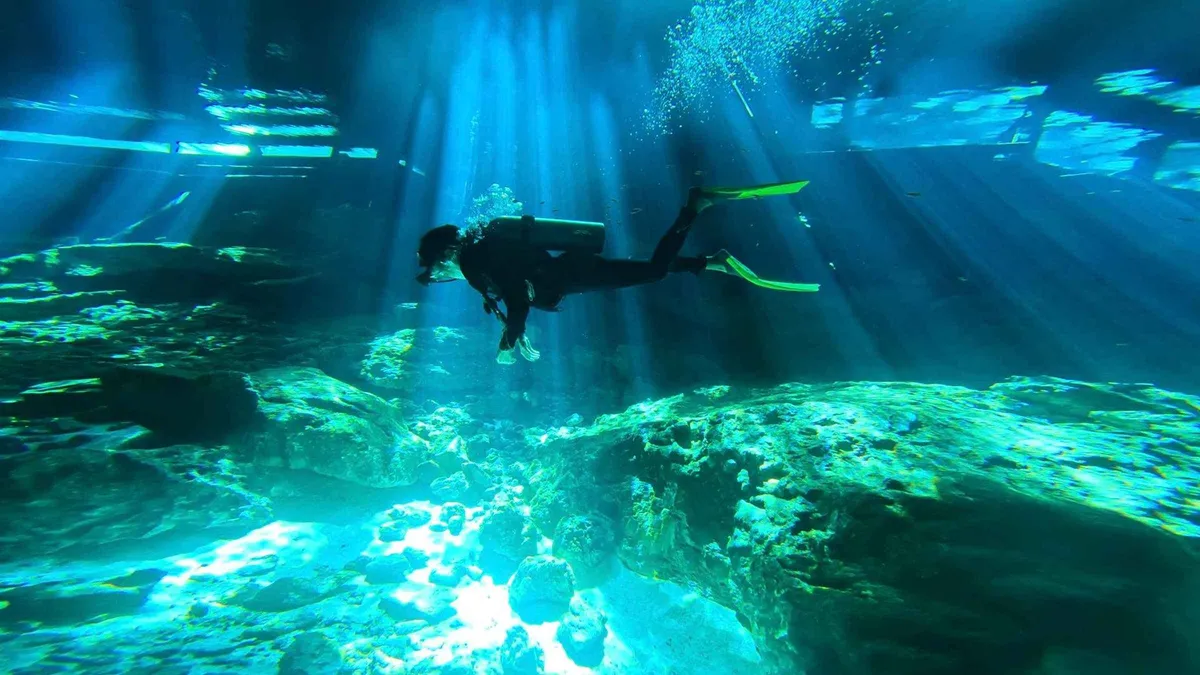 from $117.41
Tulum: Dos Ojos Cenote 2 Scuba Dives with Transfer Option
Two dives in Dos Ojos — Bat Cave and Barbie Line — with an optional Tulum transfer. Park entry about MX$400 and gear rental are due on site.
Check Availability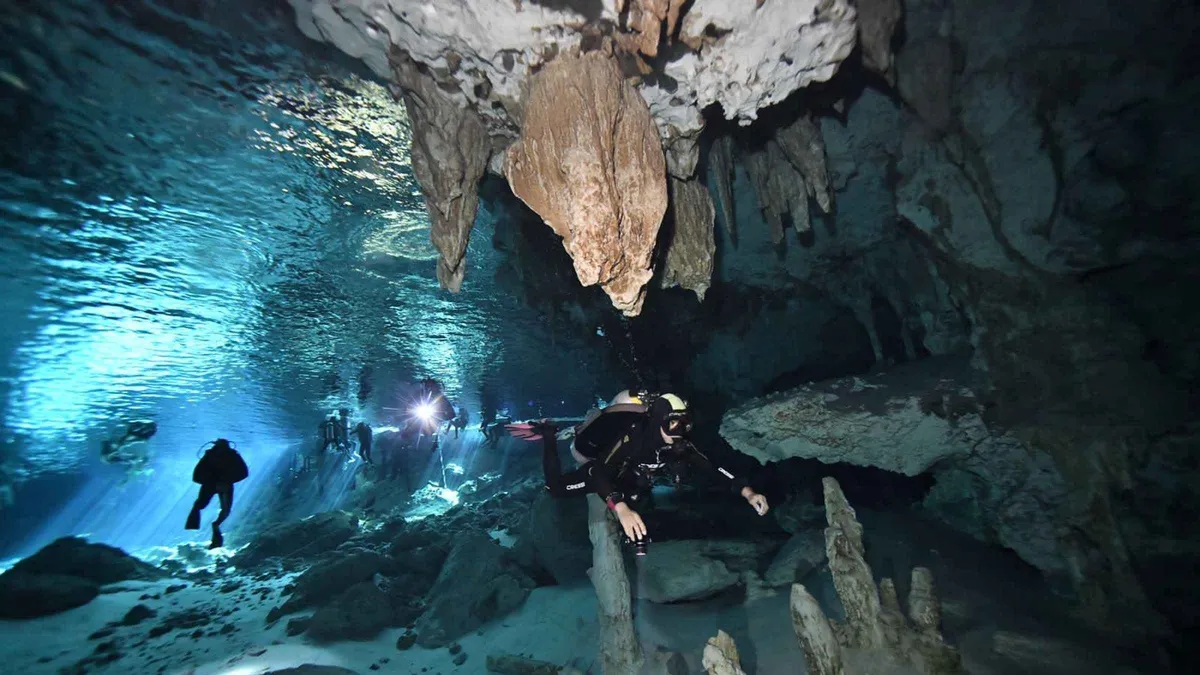 from $223.08
Tulum: 2 Tank Cenote Dive
Two guided cavern dives for certified divers, small group, tanks handled by the shop. Overhead environment: buoyancy control matters more than depth.
Check Availability from $26.09
Riviera Maya: Tulum Ruins, Mariposa & Chen-Ha Half-Day Tour
The cheapest way to pair the ruins with two cenote swims — hotel pickup, a guided walk, then Mariposa and Chen-Ha. Biggest review count here.
Check AvailabilityPrices, ratings and details are the platform's own. Dollar figures are the listed prices. The platform bills in your account's currency.
What a cenote actually is
The word is a Spanish rendering of the Yucatec dzonot, and the geology explains almost everything about the visit — including why the water is cold and why there are no rivers on this coast.
The Yucatán Peninsula is a limestone slab. Rain falling on it picks up carbon dioxide, turns mildly acidic and dissolves the rock from within, cutting caves rather than valleys. When the last ice age ended and sea level rose, those caves flooded; where a roof later collapsed, the water below was exposed and a cenote was born. That is why the water is fresh, clear and about 24 °C all year — it is groundwater, not river water, and it never sees the sun long enough to warm up.
The system under Tulum is not small. Sac Actun, the network that Dos Ojos belongs to, has more than 376 kilometres of mapped flooded galleries, which makes it the longest known underwater cave system in the world. Nothing you swim in around here is isolated: the pool you can see is a window into a network that reaches most of the way to the coast.
What they meant to the Maya
In a landscape with no surface rivers, cenotes were the only permanent fresh water, so settlement followed them — including at the ruins, where a small cenote inside the north wall supplied the city. They were also sacred: entrances to Xibalbá, the underworld, and places where offerings were made to the rain and fertility gods. Divers still recover ceramic and bone from the deeper systems, which is one reason the parks are strict about touching anything.
Getting there: colectivo, bike, taxi, tour
None of these cenotes is far, and all of them are far enough that the question of transport decides which one you visit.
The colectivos — shared white vans running Highway 307 and the Cobá road — are the local answer. They leave Tulum town constantly, stop when you wave, and drop you at the gate of any cenote on their route. The catch is the return: you flag one down on the same road, which works well until late afternoon and then thins out.
A bicycle covers the Cobá road cenotes comfortably: Calavera is about ten minutes from town, Gran Cenote a little further, on a flat road with a shoulder. Nothing on Highway 307 is a sensible cycle. Taxis have no published tariff in Tulum, so agree a price before you get in and expect the fare from the beach road to be higher than the fare from town. And a tour — three cenotes with lunch and transport — replaces the whole problem, which is why it is the most-booked shape of cenote day here.
| Cenote | Distance from Tulum town | Colectivo | Bicycle |
|---|---|---|---|
| Cenote Calavera | About 3 km west | Yes, Cobá road | Yes, about 10 minutes |
| Gran Cenote | About 4 km west | Yes, Cobá road | Yes, about 15 minutes |
| Cenote Zacil-Ha | About 8 km west | Yes, Cobá road | Possible, hot |
| Parque Dos Ojos | About 22 km north | Yes, Highway 307 | No |
| Casa Cenote | About 12 km north | Yes, Highway 307 | No |
| Laguna Kaan Luum | About 9 km south | Yes, Highway 307 | Possible, no shade |
Rules, safety and the sunscreen problem
Cenote rules look fussy until you understand that the pool you are standing in is drinking water for the whole peninsula.
Almost every gate asks you to shower before you get in, and many will send you back if you are wearing sunscreen or repellent. Biodegradable formulas are the rule across this coast, and the strict cenotes ban even those. Life jackets are compulsory at most of the parks, whatever you think of your swimming, because the guides are not lifeguards and the water is deep at the edges of the light.
The safety question people ask is whether it is safe to swim in a cenote, and for the open pools the answer is yes, with the ordinary caveats: no diving into water you have not looked into, no swimming alone, and no going beyond the guide line into the dark. Cavern snorkelling with a guide, as at Dos Ojos, is a different activity from cave diving, which is genuinely dangerous and requires certification. The line between them is a physical rope, and it is there for a reason.
- Shower first, and skip sunscreen and repellent — biodegradable at best, nothing at the strictest gates
- Life jacket is compulsory at most parks, included in the entry price
- Cash — the majority of gates take nothing else
- No drones at most cenotes; the parks set their own rule and enforce it
- No touching the formations, the fish or the turtles; stalactites take centuries to grow back
Snorkel, swim or dive
The single most useful sorting question is what you actually want to do in the water, because the cenotes do not all offer the same thing.
If you want the photograph — the light beam, the rock ceiling, the impossible blue — you want a cavern snorkel, and Dos Ojos is the standard. If you want to swim laps in cool water under an open sky, Zacil-Ha or the shallow ring at Laguna Kaan Luum. If you want to jump, Calavera. If you want to drift through mangroves and see fish rather than rock, Casa Cenote.
Diving is its own category. The cavern dives that shops run at Dos Ojos are for certified open-water divers with a guide, staying inside the daylight zone — the two-tank dive is the usual version, and it is about buoyancy control rather than depth. El Pit at MX$1,800 goes deeper and costs more. Full cave diving, beyond the light, needs cave certification and is not something anybody here will sell you on a whim.
What else is within half an hour
Driving times are our own estimates on Highway 307 outside the school-run hours.
Tulum ruins
The walled Maya port on the cliff, MX$265 for a foreign adult, open 08:00–17:00. Ruins at opening then a cenote at eleven is the standard shape of a good first day.
10 min from the Cobá-road cenotesAkumal Bay
Green turtles on the seagrass in waist-deep water, and the natural pairing with the Highway 307 cenotes. Akumal can only be swum with a licensed guide inside the protected circuit.
25 min northSian Ka'an
The biosphere reserve south of town, with a CONANP quota of MX$225 and the float down a Maya canal. Sian Ka'an is a whole day, not an afternoon.
25 min to the Muyil gateTulum cenotes: what people ask before they go
Which is the best cenote in Tulum?
There is no single answer, because they do different things. For the cavern photograph, Dos Ojos at MX$400. For ten minutes from town and a jump, Calavera. For an easy swim with children, Zacil-Ha or the shallow ring at Laguna Kaan Luum. The numbered list sorts them by road and by what each one is.
How much do the cenotes near Tulum cost?
Where a price is published, MX$300 to MX$400 — that is Parque Dos Ojos, the only operator here with a public tariff. Everywhere else the gate sets its own figure in cash and posts nothing online, which is why the price table marks those rows 'not published' rather than repeating a number from a blog.
Are the cenotes safe to swim in?
The open pools are, with the ordinary rules: a life jacket, no diving into water you have not checked, and nothing beyond the guide line. Cavern snorkelling with a guide is safe and routine; cave diving beyond the daylight is a certified activity and a different sport. The rules section covers what the gates enforce.
Can you visit the cenotes without a car?
Yes. Colectivos run both the Cobá road and Highway 307 all day and stop at the gates; a bicycle covers Calavera and Gran Cenote from town. What that does not solve is carrying cash to gates that take nothing else — or the return trip late in the afternoon. A tour with three cenotes and transport is the version that removes both problems.
How cold is the water in a cenote?
About 24 °C all year, because it is groundwater rather than surface water. It feels cold for the first minute after the Caribbean, which sits between 26 °C and 30 °C, and then it does not. Nobody here rents wetsuits for snorkelling; the dive shops rent them for the two-tank dives, where you are in for an hour.
Can you take a drone or a GoPro into a cenote?
A camera, yes, and most gates rent lockers. Drones are refused at most cenotes and inside Parque del Jaguar at the ruins. Laguna Kaan Luum is the usual exception, but the rule belongs to whoever runs the gate that day, so ask rather than assume.
The cenotes on film, before you pick one
Three comparison videos filmed in and around the same cenotes this page lists — the fastest way to see which kind of water you actually want.
We Tried Every Cenote in Tulum (Here's Our Top 10)
A ranked run through the cenotes on both roads, filmed underwater and at the gates.
Video: Two Soles AbroadThe Top Ten Best Cenotes Near Tulum
Wider coverage including the Highway 307 parks and the lagoon south of town.
Video: Mark HarrisonThe Best Cenotes in Tulum
Short, mostly underwater, useful for judging visibility and crowding.
Video: Camilla JohannesenVideos load from YouTube only when you press play.
Prices, hours and terms are set by the venue or operator and confirmed at checkout.
We may earn a commission if you book through one of our links, at no extra cost to you. Full affiliate disclosure