 Tulum City Guide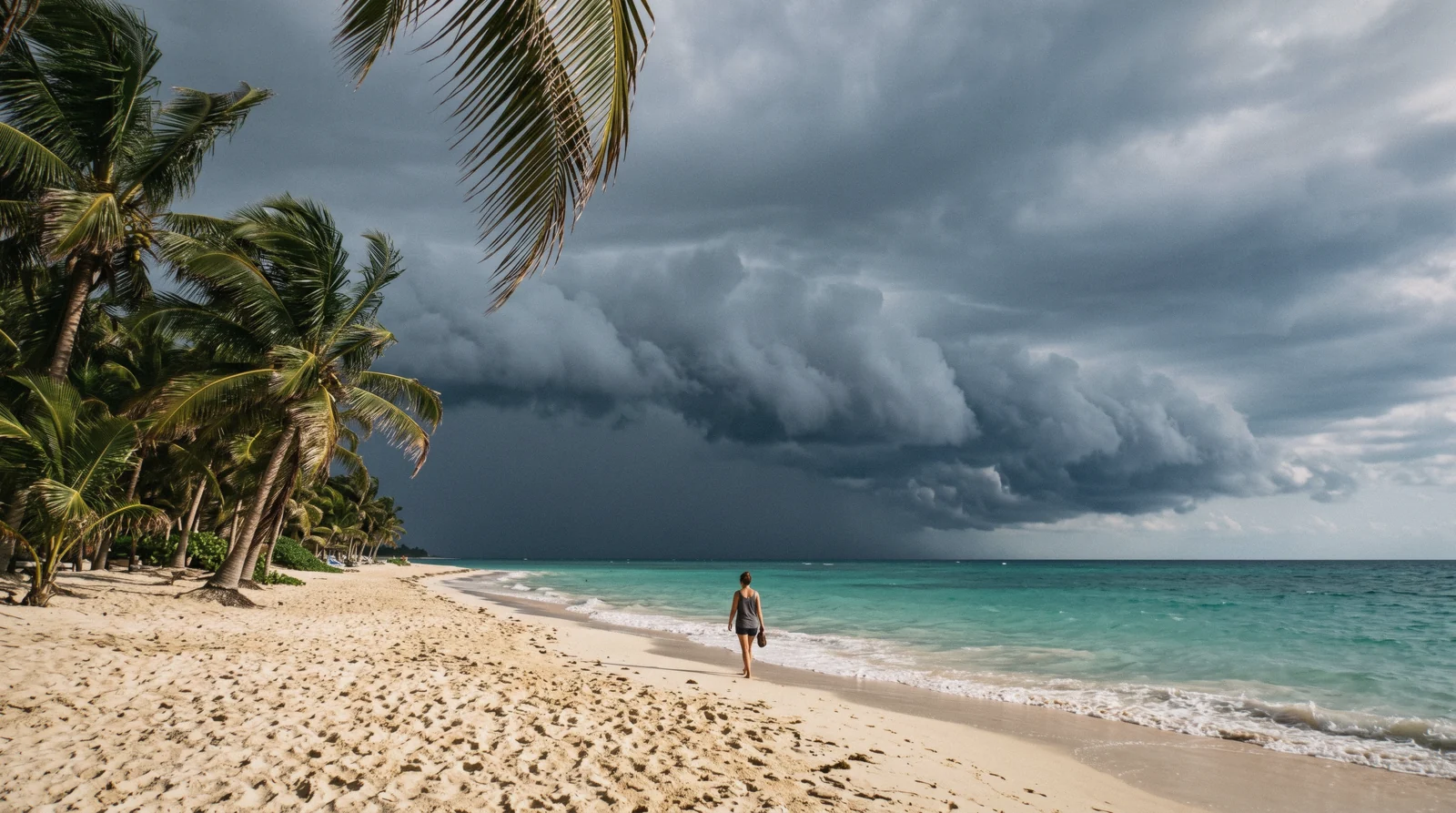
Tulum Weather, Month by Month
Tulum weather is warm all year and the temperature barely moves — average highs run from 26.1 °C in January to 30.4 °C in August. What changes is the rain, from 31 mm in February to 199 mm in October, and the wind, which is what actually cancels things. Every figure on this page comes from the Open-Meteo ERA5 reanalysis for 20.21 N, 87.47 W across 1995 to 2024. The rest of the planning sits in things to do in Tulum.
Quick answer How hot, how wet, and what the weather stops
It is hot all year in Tulum: 26 °C in January, 30 °C in July and August, and the sea between 26 and 30 °C. The dry stretch runs December to April, under 60 mm a month. June, September and October each average 180 to 199 mm, falling as afternoon downpours rather than all-day rain.
Key takeaways
- February is the driest month at 31 mm across 8.3 rain days; October is the wettest at 199 mm across 19.8
- Rain almost never costs you a day here — it costs you an afternoon, and the cenotes are indifferent to it
- Wind is the real constraint: the Akumal turtle circuits suspend above 25 km/h at sea level, and the reef snorkel goes with them
- Hurricane season runs June to November on the Atlantic calendar; the sargassum that lands on the beaches is a separate problem with no published forecast
Average daily high, month by month
Average daily high temperature in Celsius with the Fahrenheit reading underneath, computed from the Open-Meteo ERA5 reanalysis for 20.21 N, 87.47 W over 1995–2024.
The range across the whole year is 4.3 degrees, which is why in Tulum the rain decides the month and the heat does not. The bands describe averages, not forecasts. A dry-season week can be windy and a September morning can be perfect; what the record tells you is which risk you are taking.
Tulum rainfall, month by month
Average monthly rainfall in millimetres from the same ERA5 archive, with the number of days each month that see 1 mm or more underneath. The four months above 130 mm are shaded in the second colour.
Nineteen rain days in October does not mean nineteen washed-out days: the rain arrives as an afternoon downpour, and the mornings are usually clear.
Tulum weather table: temperature, rainfall and rain days
Thirty-year averages from the Open-Meteo ERA5 archive for 20.21 N, 87.47 W, 1 January 1995 to 31 December 2024, computed on 29 August 2026. Rain days count any day with 1 mm or more.
| Month | Average high | Average low | Rain | Rain days |
|---|---|---|---|---|
| January | 26.1 °C (79 °F) | 21.7 °C (71 °F) | 51 mm | 11.1 |
| February | 26.9 °C (80 °F) | 22.4 °C (72 °F) | 31 mm | 8.3 |
| March | 27.7 °C (82 °F) | 23.1 °C (74 °F) | 32 mm | 7.9 |
| April | 28.8 °C (84 °F) | 24.4 °C (76 °F) | 36 mm | 7.5 |
| May | 29.6 °C (85 °F) | 25.3 °C (78 °F) | 92 mm | 13.6 |
| June | 29.4 °C (85 °F) | 25.7 °C (78 °F) | 195 mm | 20.1 |
| July | 30.1 °C (86 °F) | 26.0 °C (79 °F) | 102 mm | 16.7 |
| August | 30.4 °C (87 °F) | 26.0 °C (79 °F) | 137 mm | 19.7 |
| September | 29.9 °C (86 °F) | 25.6 °C (78 °F) | 182 mm | 23.0 |
| October | 28.9 °C (84 °F) | 24.4 °C (76 °F) | 199 mm | 19.8 |
| November | 27.6 °C (82 °F) | 23.0 °C (73 °F) | 90 mm | 12.6 |
| December | 26.7 °C (80 °F) | 22.3 °C (72 °F) | 58 mm | 12.3 |
Two figures matter more than the averages suggest. September's 23 rain days mean rain on roughly three days in four — usually for an hour. And April's 36 mm across 7.5 days is why the shoulder month is the one experienced visitors book.
What the rain actually does to a day
The number that frightens people — 199 mm in October — describes water, not lost days.
Rain on this coast arrives as a downpour in the afternoon, often violent, usually over within an hour, and frequently followed by clear evening light. The morning is normally dry even in the wettest months, which is why every sensible plan here front-loads the day: the ruins at 08:00, the water at eleven, lunch at two, and whatever the sky does after that is somebody else's problem.
What rain does not stop: the cenotes, which are groundwater and unbothered by weather; Cobá and Muyil, which are forest sites with tracks that get muddy rather than closed; and eating, which in this town is mostly under a roof anyway.
What rain does stop: nothing, on its own. It is the wind that closes things, and a tropical storm that closes everything.
Wind, and the 25 km/h rule
The one hard number in the weather here is not about rain at all.
The federal protection programme for Akumal Bay states that turtle-swim services are suspended when the wind at sea level exceeds 25 km/h. That figure is written into the rules, and it is the reason a booking can evaporate on a bright, sunny morning. The reef snorkel off Tulum goes the same way, for the same reason: the water over the reef is shallow and choppy water makes it pointless as well as unpleasant.
Wind also decides the Sian Ka'an lagoon crossing, which is why the cooperatives run early departures. The lagoon builds a chop by early afternoon most days of the year.
So the plan-B habit worth having in Tulum is simple: if the sea is up, go inland. The cenotes do not have weather.
Hurricane season, and what it means in practice
The Atlantic hurricane season runs from 1 June to 30 November, and Quintana Roo sits in the middle of it.
Most seasons pass without a storm making landfall here, and the statistical peak is late August to early October — which lines up with the wettest months in the table above. What a near miss looks like on the ground is two or three days of heavy rain and wind, closed boat activities, and a beach rearranged. What a direct hit looks like is an evacuation, and the hotels have plans for it.
The practical advice is unglamorous: travel insurance that covers weather disruption if you are coming between August and October, a flexible booking where you can get one, and a plan that does not depend on a single boat day. Nothing about the archaeological sites or the cenotes changes in a storm season, and the shoulder weeks either side of the peak are often the best value of the year.
- June to November — Atlantic hurricane season, peak late August to early October
- Rain, not storms, is the normal experience: 180–199 mm in the wettest months, mostly afternoons
- Boat and reef activities are the first to go, and they go for wind rather than rain
- Cenotes, ruins and forest sites run through all of it
The sea, and the weed
Two different things get blamed on the weather, and only one of them is weather.
The Caribbean here sits between about 26 °C and 30 °C all year, which is why nobody rents a wetsuit for snorkelling. The cenotes are groundwater at about 24 °C and feel cold for a minute and then do not — the contrast is sharper in August than in January.
Sargassum, the brown seaweed that lands on the beaches in quantity, is not weather. It is an ocean-current and nutrient story that plays out over months, it typically affects the warmer half of the year, and no authority publishes a forecast for a given week — the state's monitoring reports are retrospective. Anybody promising you a clean beach for a date six months out is guessing. What is reliable is that the weed does not reach the cenotes, the lagoons or Sian Ka'an, which is the honest plan-B if you arrive in a bad week.
What the numbers mean for a suitcase
Nothing on this coast requires warm clothing at any time of year, which simplifies the problem.
A light rain layer earns its place from May to November and is dead weight from January to April. Long sleeves matter more for sun and mosquitoes than for cold — the forest sites at Cobá and Muyil are buggier than the coast, and repellent is worth more there than sunscreen.
Biodegradable sunscreen is not optional if you intend to get into a cenote or the Akumal circuits: it is a rule at most gates and written into the federal programme at Akumal. Closed shoes handle the uneven limestone at the ruins and the slick boardwalk at Muyil. And a refillable bottle, because tap water is not drinkable and every park asks you not to bring single-use plastic in.
The pages this connects to
Weather decides when to come and what to do on the day.
Best time to visit
The same climate record read against school holidays, prices and the sargassum months — the best-time page is the booking version of this one.
Month by month, with prices and crowdsTulum cenotes
Groundwater at about 24 °C, unaffected by rain, wind or weed. The cenote index is the standing plan B on this coast.
Weatherproof, all yearThings to do in Tulum
What is worth doing and what each thing costs — the things-to-do list marks which activities the wind can cancel.
Twelve, priced and timedTulum weather: the questions people ask
What is the rainy season in Tulum?
June to October carries the rain: 195 mm in June, 182 in September and 199 in October, against 31 mm in February. It falls as afternoon downpours rather than all-day drizzle, so mornings are usually dry even in the wettest months — the table above has every month.
How hot does Tulum get?
Average daily highs peak at 30.4 °C in August and bottom out at 26.1 °C in January, from the 1995–2024 ERA5 record. The humidity is what makes July and August feel heavier than the number suggests, and there is no shade at all inside the ruins.
When is hurricane season in Tulum?
1 June to 30 November, with the statistical peak from late August into early October. Most seasons pass without a landfall here; the normal experience is heavy rain and cancelled boat trips rather than a storm — the section above covers what to plan for.
How warm is the sea in Tulum?
Between about 26 °C and 30 °C all year, warm enough that nobody snorkels in a wetsuit. The cenotes are colder — groundwater at about 24 °C — which is why they feel bracing for the first minute after the Caribbean.
Does rain ruin a trip to Tulum?
Rarely. Rain closes nothing on its own: the cenotes are groundwater, Cobá is forest, the ruins stay open. What closes activities is wind — the Akumal circuits suspend above 25 km/h — and a tropical storm, which is a different matter altogether.
Which month has the best weather in Tulum?
February and March on the record: 31 and 32 mm of rain, highs of 26.9 and 27.7 °C, and eight rain days each. They are also the busiest and most expensive months, which is the trade the best-time page works through.
Prices, hours and terms are set by the venue or operator and confirmed at checkout.
We may earn a commission if you book through one of our links, at no extra cost to you. Full affiliate disclosure